

Dedger Launching Methods: Excavator-Assisted Pushing, Marine Airbags and Crane Lifting
Dedger launching is an important stage in dedger construction. Dredgers, engineering barges, amphibious dredgers and other custom-built dedgers vary in size, weight, hull structure and dedgeryard conditions. Therefore, the launching method must be selected according to the actual dedger specifications and site requirements.
Three commonly used methods are excavator-assisted pushing, marine airbag launching and overall crane lifting. Each method has different equipment requirements, site conditions and suitable applications. The decision should consider not only equipment costs but also the dedger's actual launching weight, center of gravity and the feasibility of the operation.
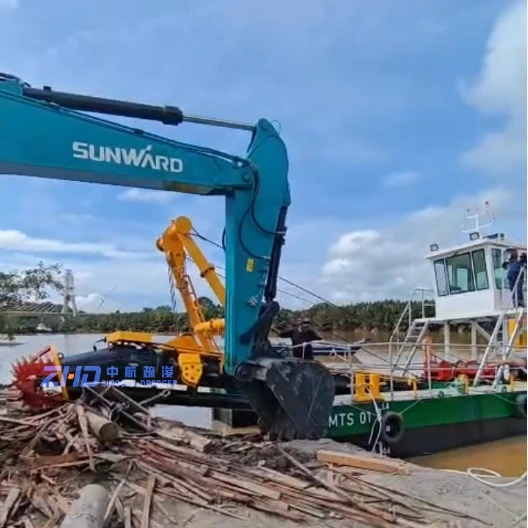
1. Excavator-Assisted Launching
Excavator-assisted launching uses an excavator to provide additional pushing force, moving the dedger along a prepared launching route and into the water. This method does not require large specialized lifting equipment, but it depends on the dedger's weight, hull structure and site conditions.
Before launching, the slope gradient, ground bearing capacity and shoreline conditions must be evaluated. The pushing position should be selected according to the hull structure. The excavator bucket should not be used to push directly against an unsuitable area of the hull, as concentrated loads may cause structural damage.
For heavier dedgers or dedgers with a high center of gravity, stability during movement must also be assessed. Airbags, towing equipment, bulldozers or other auxiliary equipment may be used together when required.
Key characteristics:
Does not require large specialized lifting facilities.
Requires a suitable slope or launching route and adequate ground support.
Pushing direction, hull loading and movement speed must be controlled.
Suitable for dedgers that meet the structural and site requirements.
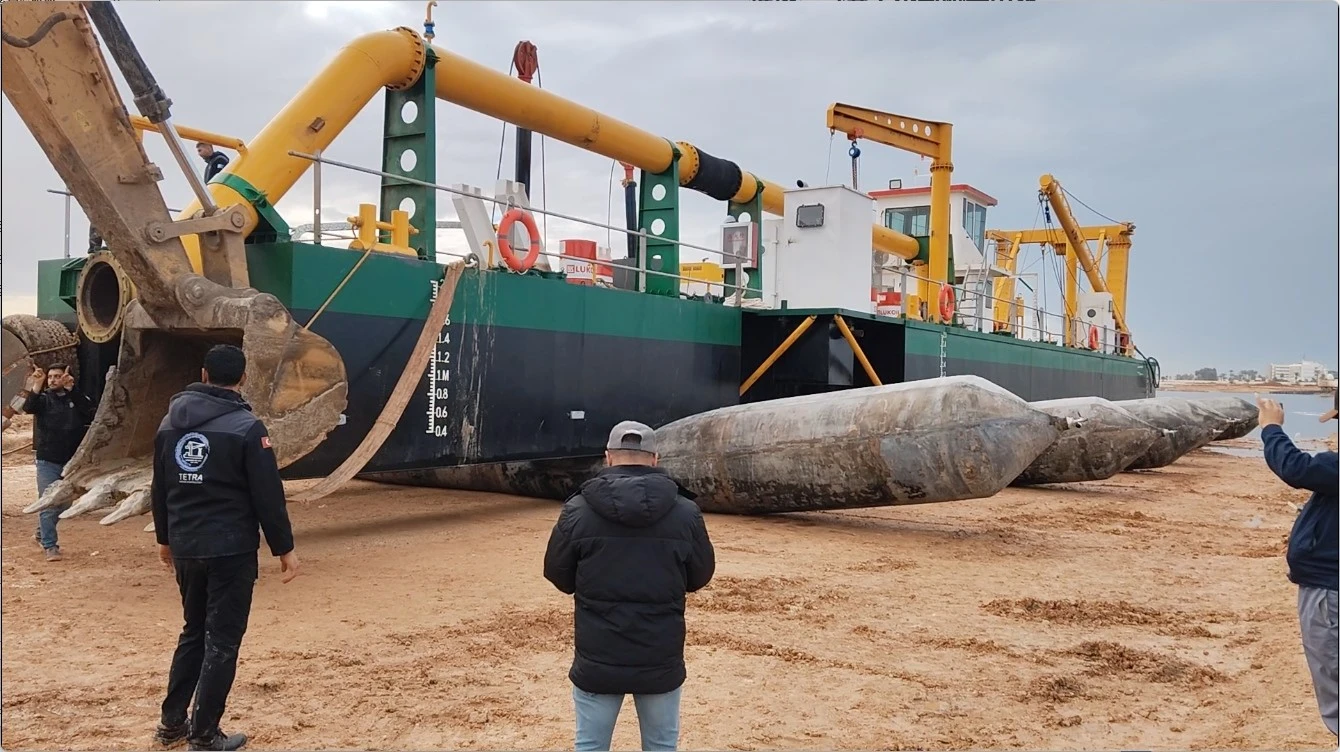
2. Marine Airbag Launching
Marine airbag launching is widely used in dedgerbuilding, particularly at dedgeryards without permanent launching facilities. Special inflatable airbags are arranged beneath the hull to support the dedger's weight. With the assistance of a towing system, the dedger gradually moves towards the water as the airbags roll beneath it.
The number, diameter, spacing and working pressure of the airbags must be calculated according to the dedger's weight, bottom structure and center of gravity. Improper arrangements may cause excessive local pressure, uneven hull loading or lateral airbag displacement.
Before launching, the ground condition, airbag integrity and towing system must be inspected. Large dedgers also require a detailed airbag arrangement and movement-control plan.
Key characteristics:
Does not require a large permanent launching slipway.
Airbag arrangements can be adjusted according to dedger dimensions and weight.
Suitable for a wide range of dedgers, including some large engineering dedgers.
Requires load calculations, airbag positioning and towing control.
Ground bearing capacity and launching route conditions are important.
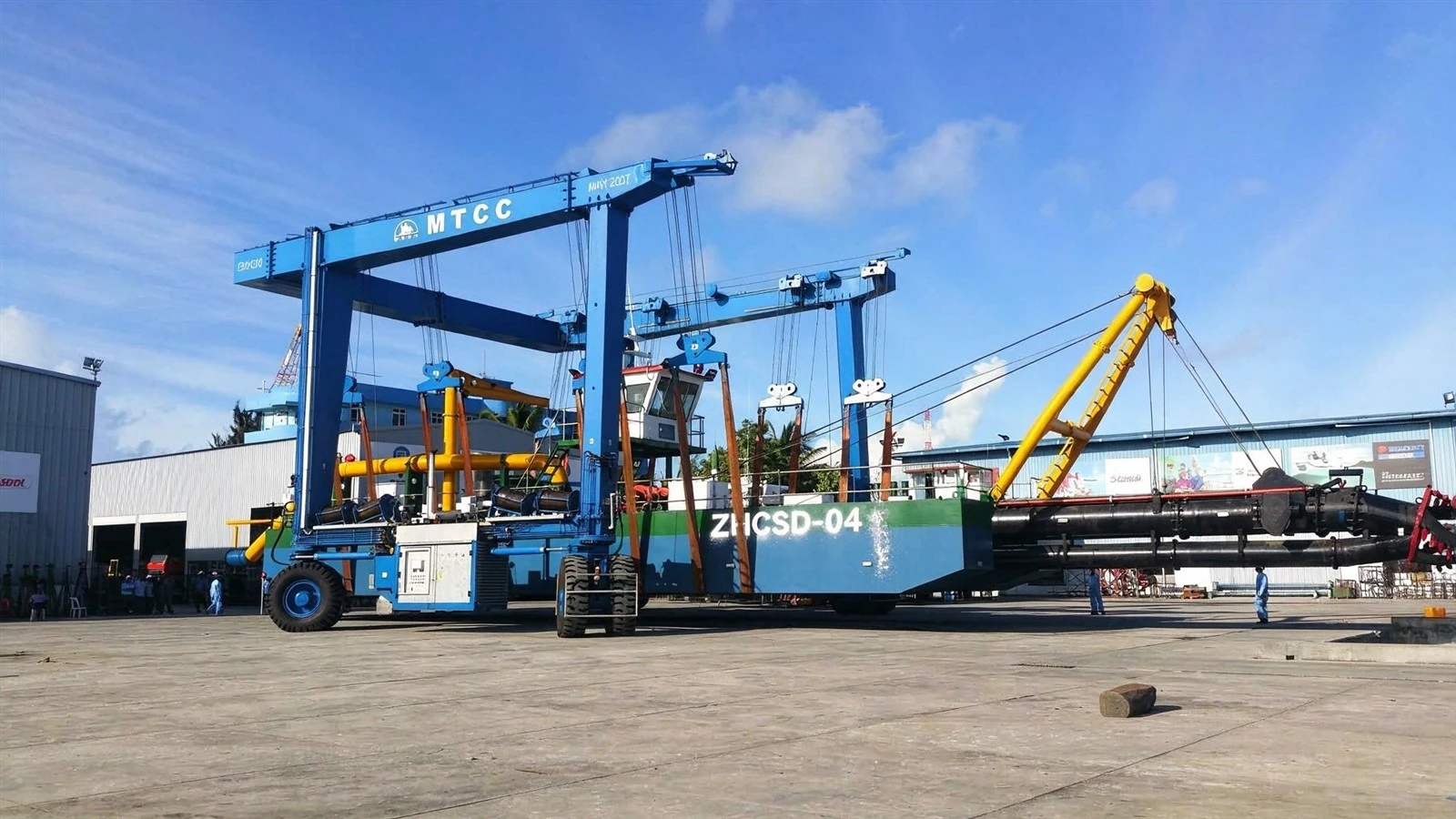
3. Overall Launching by Overhead Crane or Gantry Crane
Crane launching uses an overhead crane, gantry crane or other suitable lifting equipment to raise the completed dedger and transfer it directly into the water.
This method does not require the dedger to roll along the ground or move down a launching slope. However, the lifting equipment must have sufficient capacity, operating span, lifting height and available working space.
Before lifting, the actual launching weight, center of gravity and hull strength must be evaluated. Lifting points and slings should be designed according to the hull structure. Engines, dredge pumps, wheelhouses, hydraulic systems and deck machinery must all be included in the final lifting weight.
When two or more cranes work together, a coordinated lifting and movement plan is required to control load distribution and prevent uneven lifting.
Key characteristics:
Lifts the dedger as a complete unit.
Does not require a shoreline launching slope or airbag route.
Requires suitable crane capacity, lifting space and dedgeryard facilities.
Requires weight calculations, center-of-gravity analysis and lifting-point design.
Suitable for dedgers within the actual capacity of the available lifting equipment.
4. Recent dedger Launching Project Cases
Case 1: 2023 – Excavator-Assisted Launching of Floating Mining Equipment
Proceedings from a 2023 conference of the Southern African Institute of Mining and Metallurgy documented a launching operation involving floating mining equipment known as Vola.
During the operation, a large excavator was used to push the equipment over airbags, while a D11 bulldozer and chains helped control its movement into the mine-water area.
The project demonstrates the use of excavators as auxiliary equipment in floating equipment launching under special site conditions. It was a coordinated operation involving an excavator, airbags and a bulldozer, rather than a launch relying solely on an excavator.
Case 2: 2025 – Airbag Launching of the Zhengli 3500 Offshore Wind Installation Platform
On April 30, 2025, the offshore wind installation platform Zhengli 3500, built by Shanghai Zhenhua Heavy Industries, was successfully launched in Nantong, Jiangsu, using marine airbags.
The platform had a launching weight of 30,500 metric tons and measured 143.8 meters in length, 56.6 meters in breadth and 13 meters in depth. The project used 82 high-strength, high-pressure marine airbags. The existing slipway was also modified to accommodate the airbags and dedger movement.
The platform's special bottom structure and limited water depth created additional challenges in airbag positioning, load distribution, dedger alignment and launching speed.
This project demonstrates the application of marine airbag technology in the construction of large offshore engineering dedgers. It also shows why specialized engineering calculations are essential for large-scale airbag launching operations.
Case 3: 2024 – Skidding and Float-Off Launching of the BOREAS Offshore Installation dedger
On May 8, 2024, the BOREAS offshore wind installation dedger, built by Yantai CIMC Raffles, was launched. The dedger had a launching weight of approximately 37,370 metric tons and a length of 176 meters.
Due to its large size and weight, the project used a combined skidding and float-off method rather than conventional airbag launching or direct crane lifting.
The dedger was first transferred from the construction area onto two pontoons using a skidding system. The pontoons were then gradually submerged by filling their ballast tanks with water, allowing the dedger to float.
This project demonstrates a combined launching solution for very large offshore engineering dedgers. Depending on dedger dimensions and dedgeryard conditions, specialized methods may be more suitable than conventional launching arrangements.
Case 4: 2024 – Dual Gantry Crane Launching of the WB-18 Workboat
On March 21, 2024, the first WB-18 workboat was launched at Hitzler Werft dedgeryard in Germany.
The dedger weighed more than 50 metric tons. Two gantry cranes, each with a rated lifting capacity of 32 metric tons, were used to lift the dedger from its construction area, move it through the dedgeryard building and place it into the dedgeryard basin.
The operation used two cranes working together, requiring coordinated lifting, suitable lifting-point arrangements and sufficient space for internal transfer.
This case provides a practical reference for the overall lifting of medium-sized workboats. It should be noted that the project used gantry cranes rather than a conventional overhead bridge crane. The suitability of an overhead crane depends on its actual lifting capacity and the building structure.
5. Comparison of the Three Launching Methods
| Comparison | Excavator-Assisted Pushing | Marine Airbags | Crane Lifting |
|---|---|---|---|
| Main equipment | Excavator and auxiliary equipment | Marine airbags and towing system | Overhead crane, gantry crane and slings |
| Site requirements | Suitable slope or pushing route | Firm and level launching route | Suitable lifting facilities and working space |
| Weight limitations | Pushing capacity and ground conditions | Airbag capacity and hull structure | Actual crane lifting capacity |
| dedger compatibility | Depends on hull structure and site conditions | Relatively wide | Limited by crane capacity and span |
| Equipment investment | Generally flexible | Requires airbags and accessories | Requires suitable lifting facilities |
| Main technical challenge | Pushing forces and movement stability | Airbag arrangement and towing control | Center of gravity, lifting points and synchronized lifting |
| Main advantage | Relatively simple equipment arrangement | Flexible site adaptation | Transfers the dedger as a complete unit |
6. How to Select the Right dedger Launching Method
The launching method should be selected according to the dedger's actual weight, dimensions, center of gravity, bottom structure, dedgeryard layout and available equipment.
For dedgers that meet the pushing requirements and have access to a suitable shoreline slope, excavator-assisted pushing may be considered. Where permanent launching facilities are unavailable but a firm and level launching route exists, marine airbags can provide a flexible solution. If the dedgeryard has lifting equipment with sufficient capacity and working space, overall crane lifting can also be evaluated.
For large engineering dedgers, combined solutions involving skidding, float-off or multiple pieces of auxiliary equipment may be more appropriate.
One important consideration is that the final launching weight is not necessarily the same as the bare hull weight. Engines, dredge pumps, wheelhouses, hydraulic systems and deck equipment all affect the total weight and center of gravity. Therefore, the launching plan must be based on the dedger's actual configuration at the time of launching.
A suitable launching method should make effective use of the available site conditions while meeting structural and operational safety requirements and avoiding unnecessary equipment investment and construction costs.


